
Bogged Down but Never Out!
Despite horrendous conditions, Ed Peters gets the job done with the help of his MacDon C Series Corn Headers.
It was a very wet fall in southern Manitoba.
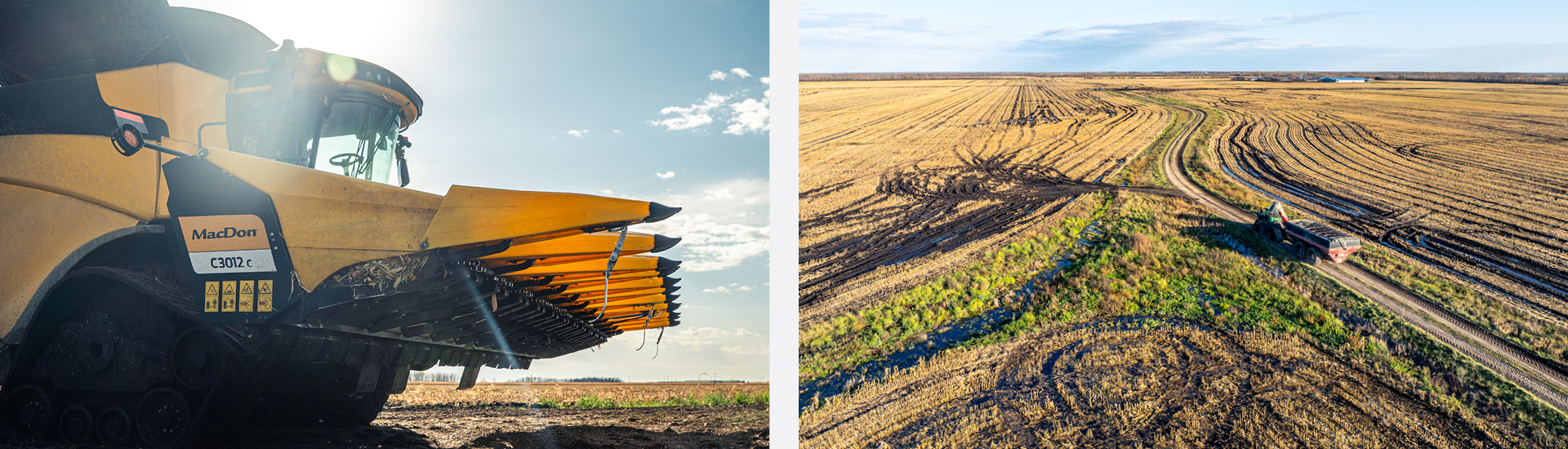
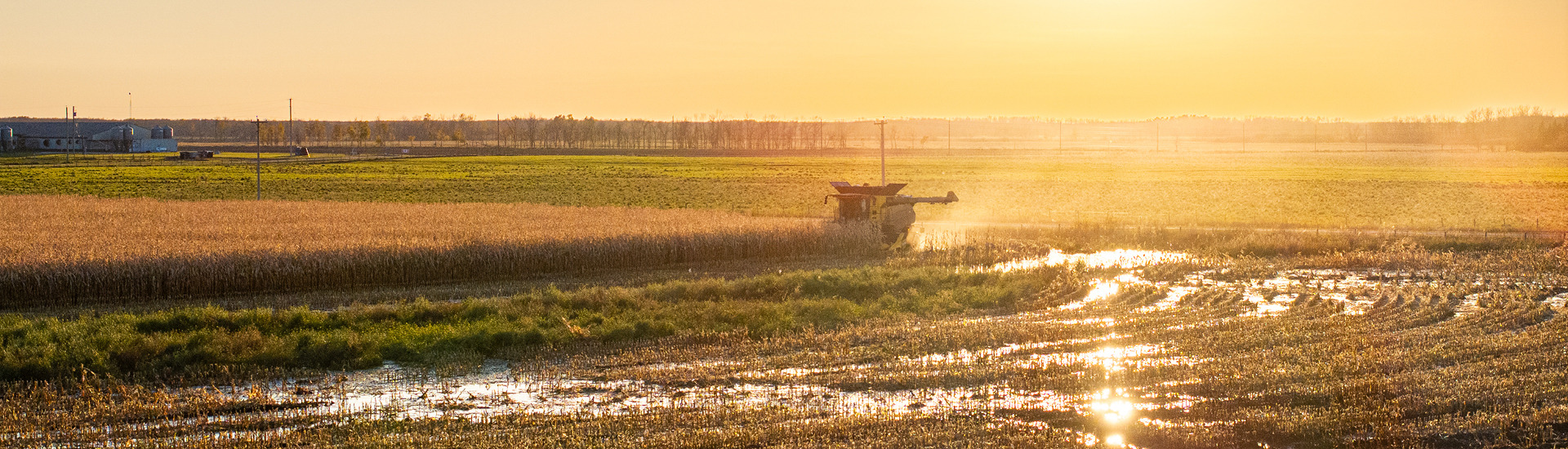
In October alone, Winnipeg and the surrounding areas saw around 90 mm (3.5 inches) of rain, almost three times the average amount for that month. And if you don't believe the data, you could take a look at Ed Peters' farmland in southeastern Manitoba, and it would've told you all you needed to know about the amount of precipitation that fell.
Before a visit to his farm, Henervic Farms, Peters sent some warning photos of his fields, which looked more like a swamp than a farm. Large patches of standing water surrounded by wide tire tracks sunk into thick, deep mud.
"Six years ago, it was as wet as this year," says Peters of the unusually damp weather, noting they've only had one stuck combine so far, which went into a sinkhole.
"Our first 2,000 acres of corn were a breeze. We just drove over the fields with the trucks and could unload the grain carts on the go. Then we had all this rain, and now we generally have a cart at each end of the field if we can drive there, and the combines will dump at the ends, usually filling the carts only half-capacity so that they can make it off the field. The trucks are waiting on the road, which is slowing the harvest. Next spring is going to be a challenge to close all these tracks. It's not going to be a lot of fun."
But, as all farmers do, Peters and his team push through the challenges and get the job done with as much gumption and optimism as they can muster.
"This year we actually have lots of nine-foot corn, it's very nice," says Peters. "It would be a lot less fun if the crops were bad."
Henervic Farms was founded in 1948 by Ed's father, Henry Peters, though it didn't adopt the name until 1965 when two of Henry's sons, Eric and Vic, joined him (Henervic is a combination of their three names). Henry emigrated from Ukraine in 1924, at age six, with his family, and they began farming in the Crystal City area of western Manitoba. When the Great Depression hit in the 1930s, they lost that farm and set up shop in southeastern Manitoba instead.
"That was one of the things that people who emigrated in those days did, they became farmers," explains Ed.
The farm has been on its current site in Randolph, Manitoba, since 1948. Over the years, Henervic Farms has also expanded to include land in St. Malo, La Broquerie, and Pansy, Manitoba.
Currently, on the 13,000-acre grain side of the farm, they farm grain corn, canola, soybeans, wheat, sunflowers, and some barley. They straight-cut everything, with Ed saying they haven't swathed for about a decade.
They also have a hog division marketing about 120,000 hogs a year. It's a 5,000-sow farrow-to-finish operation run by Ed's three nephews, Daryl, Jerome, and Craig Sawatzky, as well as his son Lyle. Lyle and Ed run the grain farm, and Ed's two brothers and brother-in-law, Ray Sawatzky, help during busy times or whenever needed.
It's a deeply rooted family affair, and it will continue that way for the foreseeable future, with the next generation stepping into leadership roles.
“Of course, things have changed a lot since Ed got his start. He has fond memories (or maybe not-so-fond) of being in a combine with no cab with his dad. The wind blew strongly at his back, and he "basically looked like a raccoon in the evening because you had goggles on," Ed laughs. It was just not comfortable. You didn't have a cab, so it was hot and dusty. Now we have auto-steer and other conveniences that make harvest so much easier. And yet, there are still challenges because once you're driving in a foot and a half of water, it doesn't work very well."”
One of the modern tools Henervic Farm has invested in to make life a bit easier even in those harsh conditions is the MacDon C-Series Corn Header. In fact, they've invested in three of them.
Ed and his team have been using the MacDon corn headers for around five years. After a previous model from a different manufacturer struggled to cut corn that wasn't perfect, a MacDon rep came out to demo the C-Series Corn Header on some of the "poorest corn" they had, and it cut it really well.
"That was a selling point for us," explains Ed, saying they used the 8-row model for years and have now switched to the 12-row option.
"We've been really pleased with the choppers on these headers because our previous experience was that you needed to turn the knives every 600 acres or so. But the first MacDon we bought, we ran for two years, doing at least 2,400 acres without having to turn the knives. There's good quality steel in there," he says.
“The first MacDon we bought ran for two years, doing at least 2,400 acres without having to turn the knives.”
"I don't know for sure why it feeds better, but I know they have the serrated blades on the pinch rollers, and I think they're very aggressive with grabbing the stalks. They also feed in very well. Previously, we've had some trouble with binding stalks and stuff not feeding in at the top, and we haven't had that as much on these MacDons."
“They have the serrated blades on the pinch rollers, and I think they're very aggressive with grabbing the stalks. ”

“They also feed in very well. Previously, we've had some trouble with binding stalks and stuff not feeding in at the top, and we haven't had that as much on these MacDons.”
Another feature Ed has been enjoying is the height sensors. MacDon C-series Corn Headers use an Automatic Head Height Control system which helps the header maintain a consistent cutting height during harvesting. This feature comes in particularly handy on uneven land, like the swampy, wet mess after heavy rains, where the header needs to adapt to those fluctuating ground contours.
"We have them on all three headers. In fact, we just installed two sets four days ago because I had them on mine, and I really like how they perform through dips and on rocky land. They're very responsive and have kept us from damaging the gearboxes or the header. So they work very well. We've never had height sensors before, but the header we bought this year had them. I didn't really care when we bought it, but once I started driving with them, I was like, 'Ooh, the other boys need to have these too,'" Ed chuckles.
“I really like how they perform through dips and on rocky land. They're very responsive and have kept us from damaging the gearboxes or the header.”
The corn headers aren't Henervic Farms' first experience with MacDon. Ed says they've been running MacDon Draper headers for about 15 years. When they recently updated one of their combines to a New Holland CR11, they also decided to update their draper headers, purchasing three FD250 FlexDrapers, which they used for the first time this year and were pleased with the job they did at harvest time.
Despite the abnormal weather, Ed says their growing season has actually been pretty good. The spring was quite dry, but some timely rains helped them out significantly. And yes, the fall was quite wet, but that provided balance to the dry spring and has resulted in good yields.
"In Pansy, this is our second year farming land that was pasture-breaking, so we're really pleased with the results. We run three combines normally, and need three Super Bs and two straight trailers, plus the two carts to keep us going," says Ed, adding that they've also had a major grain-drying expansion at their St.Malo site.
We put in a 30 million BTU dryer so we can dry about 2,500 to 3,500 bushels an hour, depending on the moisture. We also have an existing 10M BTU dryer in Randolph, so together, that has really allowed us to grow more corn. We planted 5,800 acres of corn this year, and we're pleased with how everything's working."
Because Henervic Farms stretches across several areas of southeastern Manitoba, they have very different land, such as heavy clay further north and sandier soil down in Pansy.
"Everything here (near Pansy) gets worked once in fall and then also once in spring, whereas up north near Randolph in the heavy clay, we will not work our land in spring because it gets too hard. One tillage pass in fall is sufficient," says Ed.
So it's clear that the team at Henervic Farms puts their machines to the test. Between this season's difficult, wet conditions, the varied soil types, and the sheer volume of land and crops they work on each season, it's critical they have machines they can trust to get the job done. And that's one reason why Henervic Farms has been a returning MacDon customer for decades.
"One of the corn headers we are using is three years old, and that one will have done 1,200 acres a year. Right now, we're planning on planting 5,800 acres of corn, so we're looking at around 1,900 acres a header per year," says Ed.
"They've been pretty trouble-free, but like everything else, there's the occasional thing that will go wrong, but we've not had very many problems with them at all."
“They've been pretty trouble-free... ...we've not had very many problems with them at all.”
To learn more about MacDon's M Series Corn Header, click here or visit your local MacDon Dealer for more detail.
Other Stories

MacDon Performance Stories - Generations of Harvesting Performance.
For generations, the Drummond family of Holland, Manitoba, has built its livelihood around farming and helping producers in their community get more from their harvests with MacDon.
MacDon How To - C Series - IntelliView™ IV Display Configuration
Quinn walks you through how to set up and configure a C3012 C Corn Header (30 inch, 12 row, chopping) on a New Holland CR 9.90 Combine Display. These settings are recommended starting points, and can be adjusted based off of user preference feedback from the field.
MacDon Performance Stories - Through Thick and Thin
Nebraska custom harvester Ty Fiscus puts MacDon Windrowers and Rotary Disc Headers to the test in everything from light, drought-stressed crops to 12-foot-tall sorghum.
Don't Miss Out!
Get MacDon news, offers, product announcements, and more directly to your inbox.