
Scorching Performance
Arizona's relentless heat puts every harvest to the test. Glen Crane counts on the one-two punch of MacDon's R1 Front-Mount and R1 Pull-Type to stay ahead of the crop.
In the south eastern most corner of Arizona, right on the border with Mexico, sits Cochise County. An agricultural powerhouse, more than a quarter of the county’s area is dedicated to farmland, which means over a million acres of space to grow common crops such as hay, corn, cotton, and small grains, to run beef and dairy farms, and to produce the region’s most famous export, tree nuts.
Cochise County alone contributes over a third of the state’s pecans and is the world's second-largest pistachio-producing area behind only California. And while it is the second-largest in pistachio production, Cochise County is the second-smallest county in Arizona by population, with around 125,000 people.
Glen Crane lives and works in the small city of Buckeye in Maricopa County. His family has run a custom-cutting business in the area for more than 40 years. Crane Harvesting and Trucking largely cuts corn and wheat, bales hay, and works with other specialty crops, including Bermuda grass, okra seed, onion seed, and asparagus, throughout Arizona, including Cochise.
Crane says he and his team can work almost 12 months a year, often starting at 6:15 a.m. and working until dark.
“We’ll chop hay all winter long here… When we harvest the corn, they put the wheat in. When we harvest the wheat, they plant the corn,” he explains.
“We do about 20,000 acres of wheat here. And we'll come back and do about 12,000 acres of corn.” Crane’s dad was the one who started the business. He started out trucking in 1962 with one partner; they bought one truck and grew from there. Just a few short years later, they decided to buy some combines. A local farmer was looking to get rid of his, so the pair of men took advantage of a good deal and jumped into the combine business.
It wasn’t until the early 1970s that Crane’s father bought his first forage harvester, a New Holland. Over the next 20 years, he acquired another New Holland and then a CLAAS, and by the year 2000, he was “in the chopping business pretty strong,” as Crane explains it.
Now, Crane Harvesting and Trucking has 15 forage harvesters and about 100 employees.
“I think in ‘94, my dad, he was all excited we were going to have a good year; we had a million dollars worth of gross. In the last, I don't know, seven or eight years, it's been close to 30 million,” Crane says.
And from the early 2000s onward, during a period of immense growth and success, MacDon has been the brand of choice for Crane Harvesting and Trucking.
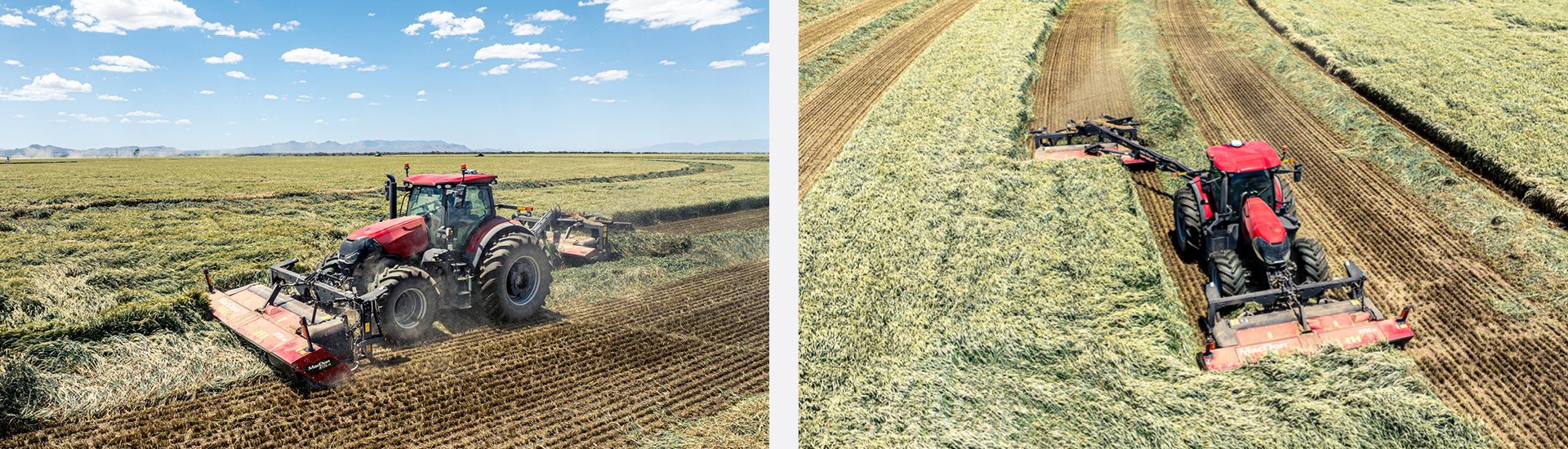
Crane currently runs five M1240 Windrowers and “a couple” of M205s, but the star of the show is his R116 Front-Mount Rotary Disc paired with the R1 pull-type.
Under an unrelenting May Arizona sun, Crane does a walkaround of his R116 FR, happily showing off the features of the unit and offering to physically show how far it can throw the hay or wheat or whatever it has cut. Later, in a nearby field, the R116 FR and R1PT move frictionlessly through a dense crop of wheat, leaving tidy, well-formed windrows.
The R1 line of rotary disc headers is known for speed, precision, and power. And the R1 FR, a 2025 AE50 award winner, provides high output while requiring less horsepower. When paired with the R1 Pull-Type (a combo Crane takes advantage of), customers can get twice the coverage in one pass, with a max cutting width of 32 feet.
While some triple-mower models could compare in terms of output, Crane much prefers the R1FR and PT setup.
“At home, it fits our borders perfectly, and here it does the same, and here we can get dang near a true 32 feet. Where the triple mower, we're more like 29 ½,” he says.
“With the (other brand) triple mower, you can’t see the head in front of you, and then you're looking over here. I'm not a big fan of the triple mower… our rakes are set up for this; everything just fits this better than a triple mower.”
And when the Double Windrow Attachment is in the mix, the R1FR and R1PT have additional merge capabilities. The DWA “further increases productivity by reducing post-cutting passes.” As explained on MacDon’s website, the R1 PT's DWA creates single-pass double windrows when paired with the R1 FR.
“My boy ran it for three or four days, and he’s like ‘Man, this is it.’ He was cutting some wheat… and he was running at seven miles an hour, and he could make a really, really nice windrow with it.”
“My boy ran it for three or four days, and he’s like ‘Man, this is it.’ He was cutting some wheat… and he was running at seven miles an hour, and he could make a really, really nice windrow with it. You can speed that belt up or slow it down. It was just a beautiful windrow,” says Crane.
When asked what the biggest challenge to his operation is, Crane has a quick, two-word response: the heat.
The average summer high in Crane’s area of Arizona is around 90 degrees Fahrenheit in July and August.
“It's been pretty mild here this year so far, but it'll get 100, 108 here. It just comes on, like these guys, they want this wheat in a soft dough, and they really don't want you to start before that. And when it gets to that spot, and you've got eight or ten thousand acres ahead of you, it can be a challenge because when it's hot, it dries fast,” he says.
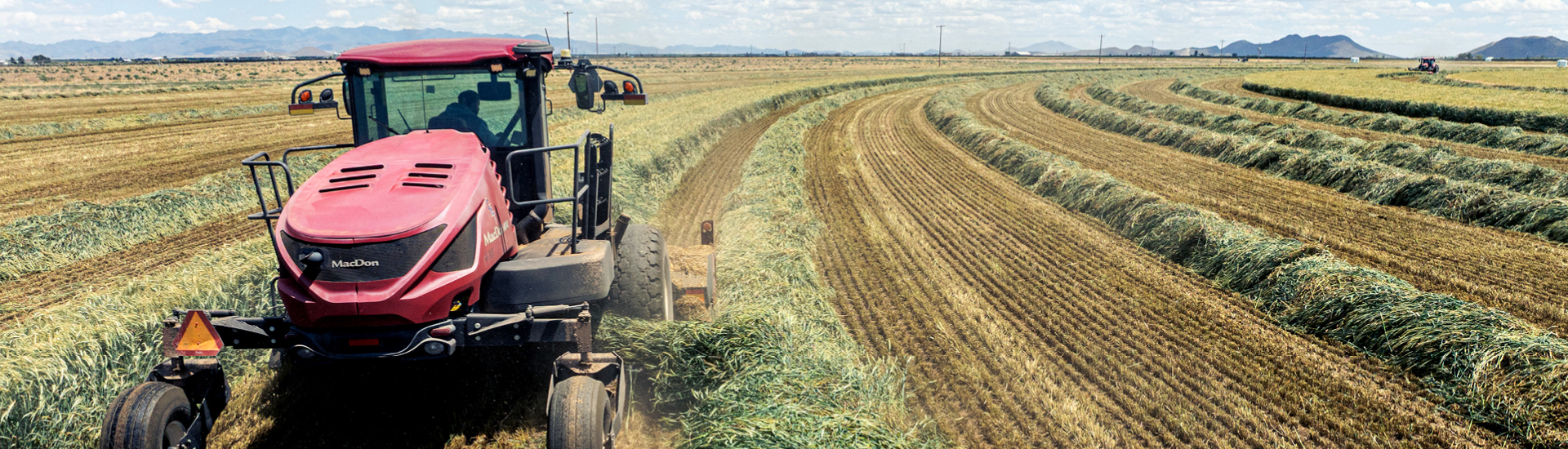
And, of course, in the desert, access to water can also be a challenge. In Cochise County, pivots — an automated irrigation method that involves a long pipe attached to wheeled towers that rotate around a fixed central point to water the area — are the norm for keeping everything hydrated, especially during the high-heat seasons.
“Here in this area, all the water comes from wells out of the ground. And they can irrigate; they can start and turn them pivots on whenever they want. Up in the Phoenix area, that water there is all canal water. Some of it's pump water, but a lot of it comes out of lakes, down canals, laterals, ditches, and it finally gets there,” he says.
“I know the Northwest, they get a lot of water out of the Columbian River. They just pump it out of the river and pump it in the pond, and they suck it out to the pivots. Over here, about every pivot here has a well. We’re a little short on water down here.”
“That’s all we run on our combines now, is MacDon drapers… …they’re pretty reliable. ”
But one thing Crane can always count on, even during the hottest, longest days, is his MacDon equipment – “That’s all we run on our combines now, is MacDon drapers,” he says. “We don't have much trouble with them; they’re pretty reliable.”
“It doesn't take them much to learn how to run it; it's pretty simple. And they run 25 miles an hour down the road.”
“It doesn't take them much to learn how to run it; it's pretty simple. And they run 25 miles an hour down the road, that's friendly,” says Crane of the MacDon windrowers.
“They're just good… we can pop that rotary head off and have the draper head on and in 10-15 minutes, and we're ready to roll.”
“They're just good… we can pop that rotary head off and have the draper head on and in 10-15 minutes, and we're ready to roll… MacDon’s got the best draper head, and they're easy to change, and it's just the only way to go for us.”
Visit our product pages to learn more:
R1 FR Series Front Mount Rotary Disc
R1 PT Series Pull-Type Rotary Disc
R2 Rotary Disc Header
Additional Resources:
MacDon Performance Parts
Owners Resources
How To Video Library
MacDon Dealer Locator
Otros cuentos

MacDon Performance Stories - Generations of Harvesting Performance.
For generations, the Drummond family of Holland, Manitoba, has built its livelihood around farming and helping producers in their community get more from their harvests with MacDon.
MacDon Performance Stories - Through Thick and Thin
Nebraska custom harvester Ty Fiscus puts MacDon Windrowers and Rotary Disc Headers to the test in everything from light, drought-stressed crops to 12-foot-tall sorghum.
MacDon Performance Stories - When Harvest Makes Cents.
Jake Freestone took a risk by pioneering the first MacDon FlexDraper® in the U.K., but a decade later, the results speak for themselves.
Don't Miss Out!
Get MacDon news, offers, product announcements, and more directly to your inbox.