
Through Thick and Thin
Nebraska custom harvester Ty Fiscus puts MacDon Windrowers and Rotary Disc Headers to the test in everything from light, drought-stressed crops to 12-foot-tall sorghum.
It’s been a very dry year in Nebraska.
Much of the state continues to deal with drought conditions after suffering through the warmest winter on record since the Dust Bowl. An historic agricultural and environmental disaster in the 1930s, during which dust storms swept across parts of the U.S. and Canada, destroying crops and homes and forcing millions to migrate elsewhere.
Local news outlet Nebraskapublicmedia.org reports the 2026 wheat harvest “appears to be on track for one of the worst in history and led many wheat farmers to abandon their fields altogether,” and that as of July, a quarter of the state was experiencing “extreme drought” conditions. And it’s not just wheat – sugar beets, corn, hay, tree health, and the unrelenting dryness has negatively impacted just about everything else. One farmer was quoted as saying, “We’re not even seeing weeds germinate.”
The drought, coupled with wildfires that have also been devastating the region due to the lack of rain, has made for a stressful season for everyone in Nebraska’s agricultural industry.
“This year has been exceptionally dry; very, very little to no rain this season. I've read that we are in a record drought since they started taking records of rainfall. We are at the peak of the least amount of rain over the winter months and into the spring. So with that, the crops are suffering. They are quite a bit shorter than normal,” explains custom harvester Ty Fiscus, who’s based in Oshkosh and estimates 99 percent of the acres he’s harvesting this season are irrigated land due to the drought.
“This triticale that we're in right now is probably going to ton out around six to eight, and on an average year this would probably be 12 to 15, maybe some 17-ton triticale in there. So the tonnage is going to be short. With the spiked fuel costs, it's just making it that much more difficult to operate this year.”
As a custom harvester, though, Fiscus is used to changing plans at the drop of a hat.
“That's the fun thing about being in the custom business is, every day is a new day; it's not the same thing every day; you make a plan, and sometimes it works, and sometimes you have to completely change your plan because every field, every acre is different,” he says.
Fiscus owns and operates Fiscus Custom Swathing, which is in its third year of operation. He started working in 2020 for longtime custom swather Pete Marshall, who had been in the business for more than 30 years. Still, Fiscus has been around the industry since he was a kid watching his grandfather run a custom haying business of his own. When he was in high school, Fiscus worked with his grandfather and got introduced to the business.
When he relocated to Oshkosh from Scotts Bluff County, NB, he was introduced to Marshall, and the rest is history. After five years of working together, Marshall decided to retire, and Fiscus took over the operation.
“Haven't looked back since. We just keep on trucking along, I guess,” Fiscus says.
Marshall was also the guy who introduced Fiscus to MacDon products. With three decades of experience under his belt, Marshall swore by MacDon, which was enough of an endorsement for Fiscus to continue using them when he took over the operation.
This season he’s running three units: two M1240s and a new M2260, and he has been impressed with their speed, efficiency, and durability.
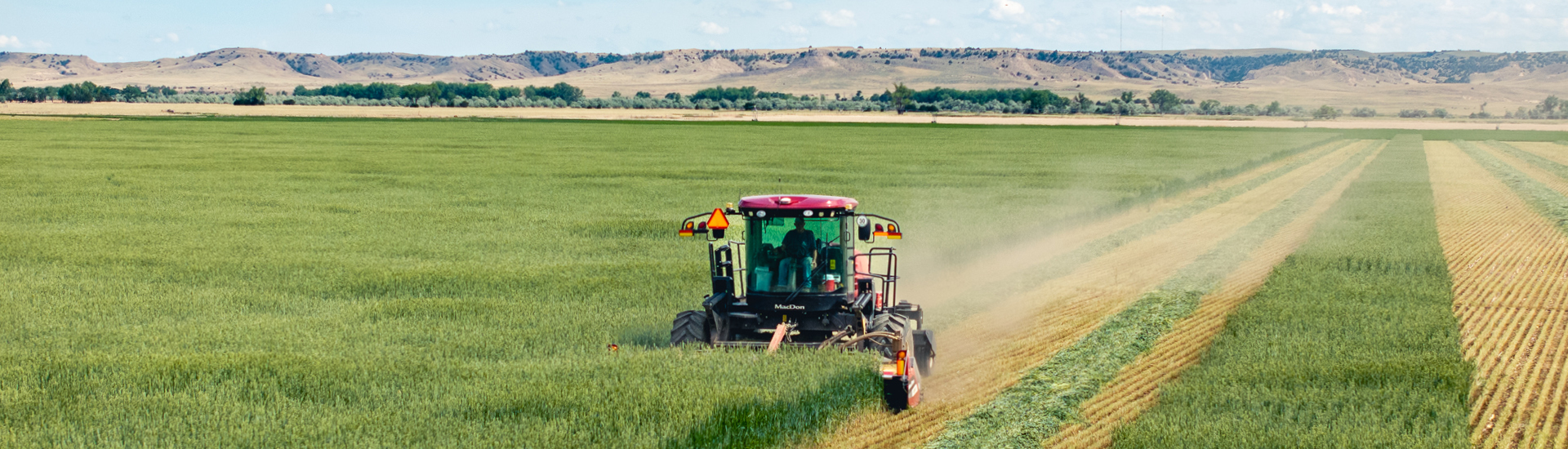
“They just keep running,” he says. “We cover probably 7,000 to 8,000 acres a unit. Putting 500 to 700 hours a year on them and they just keep purring like a kitten and running strong. I don't know if I'd ever go to a different brand. Why change when these are working beautifully?”
“We cover probably 7,000 to 8,000 acres a unit. Putting 500 to 700 hours a year on them and they just keep purring like a kitten and running strong.”
The M2260 brings a bit more horsepower to the table than the 1240s: 248 HP on the M1240 versus 280 HP on the M2260, as well as a more advanced Stage V 6.7L 6-cylinder engine built to handle extreme forage loads. The M2 Series Windrowers can also reach an in-field harvesting speed of a very zippy 18 mph and a road transport speed of up to 28 mph.
Fiscus is also using the most recent iteration of MacDon’s R Series Rotary Disc Header on the front of his windrowers, the R216, a 16-foot head known for its clean cutting, precision controls, and high-capacity conditioning for hay and grass crops.
The conditioner roll conditions the crop by crimping and crushing the stem in several places, allowing moisture to be released to speed drying times. Conditioner rolls come in two options: steel and polyurethane. Steel is ideal for aggressive crimping in high-volume, thick-stemmed crops, so that was the way to go for Fiscus.
“All of our units run the steel conditioners; if I'm not mistaken, I think they're the industry-leading widest conditioners in a swather right now. I believe we can lay down a 12-foot-wide windrow if needed, potentially maybe a 13-foot windrow, so in drying time that plays a big factor into being able to get the crop on the ground and get it drying and get it put in a bale or get it put in a pile when you need it,” explains Fiscus.
“But with the custom business, you just never know what you're going to run into; we've had pivot tires stuck in our conditioners, we've had wood posts, we've had metal posts, we've had just about anything you can think of, and these steel conditioners just keep on going, very little wear. This machine, I think, has 20,000 acres on it and shows very little wear on the steel conditioners; it's still drying the crop just like the first field I pulled it into.”
“We've had pivot tires stuck in our conditioners, we've had wood posts, we've had metal posts, we've had just about anything you can think of, and these steel conditioners just keep on going, very little wear.”
In addition, all of Fiscus’s machines have the Double Windrow Attachment, or DWA. The DWA allows users to combine up to three passes into a single windrow, saving time and fuel with large forage harvesters. Fiscus says the DWA's ability and versatility to merge windrows has helped his business, and that they’ve implemented it into the baling on lighter crops, throwing two or three windrows together and reducing the acres needing to be raked, as well as the distance between acres getting raked.
“For the chopping it works really, really well,” he says.
“We've cut anything from short, dried-up cheatgrass to 12-foot-tall sorghums, and there doesn't seem to be anything that these R216 heads can't handle; they are very impressive heads. With the earlier model R85, we had a little bit of trouble with the lighter prairie haze or cheatgrass streaking in and such, but these R216 heads have been pretty incredible. We haven't had any issues with any of it, whether it's light or 12-foot-tall sorghums, it'll cut it. I've cut sorghum taller than this machine going 10 to 12 miles an hour, and it just goes right through.”
“We haven't had any issues with any of it, whether it's light or 12-foot-tall sorghums, it'll cut it. I've cut sorghum taller than this machine, going 10 to 12 miles an hour, and it just goes right through.”
And perhaps almost equally important to that breadth of use is the ease of maintenance. Fiscus says he and his team can handle 90 percent of their repairs and maintenance in-house, which saves them a ton of downtime if anything should happen in the field. He also says the maintenance is typically “extremely easy” and allows him to end his long cutting days without spending additional time fixing machinery issues.
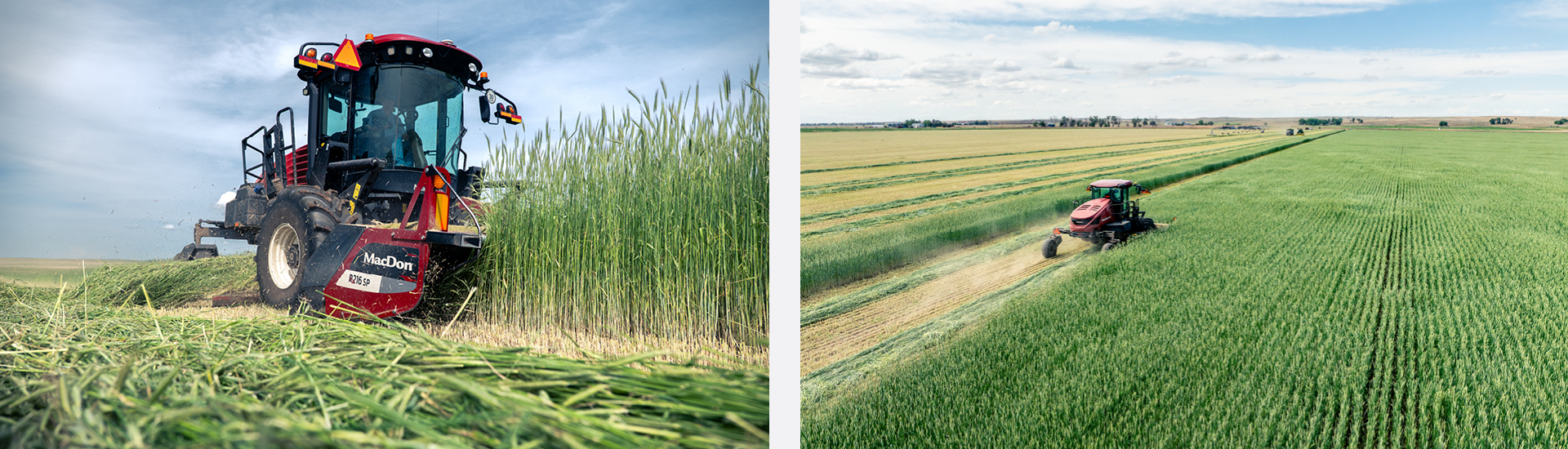
“On this unit (M2260) we had a bearing on the bottom roller that was going out, and I had the bearing; I was probably seven, eight windrows ahead of the chopper and I was able to replace that bearing and be back running before the chopper caught up to me. I would say it was 15, 20 minutes, and we had the bearing off; luckily it slid off the shaft, and we were able to replace it to get back to operating,” says Fiscus.
“We had a bearing on the bottom roller that was going out… I was probably seven, eight windrows ahead of the chopper, and I was able to replace that bearing and be back running before the chopper caught up to me.”
“The grease is 25-hour increments, so you can run two to three days and not have to grease. You can get out of the machine at night, go eat supper at home. You don't have to worry about working on a unit at the end of the day. It starts right back up, and back to work you go.”
With all the features, options, and settings, one might assume the learning curve for using these windrowers and headers is steep, but Fiscus has found the opposite to be true. Despite the array of each machine’s capabilities, it has been easy to train even the greenest users to run the swather; in fact, he’s even been able to do it over the phone.
“It's as easy as ABC on one of these swathers,” says Fiscus. “You have all your presets on your buttons, and you can basically tell them in one conversation the entirety of the machine, and they can get in here and go to running it for you. The simplicity of the machine is unmatched; I've tried other models, rode in them, drove them some, and the ground speed lever with the simplicity of it is unmatched. It's pretty straightforward, and you can figure it out pretty easily.”
“You have all your presets on your buttons, and you can basically tell them in one conversation the entirety of the machine, and they can get in here and go to running it for you. The simplicity of the machine is unmatched…”
The technology has obviously changed a lot since Fiscus’s grandfather ran his small operation decades ago with an old New Holland pull-type. And while it’s good to maintain some aspects of “the old way” of doing things, the efficiency and output (and of course, the luxurious deluxe cab with leather seats that can be heated or cooled as needed) of MacDon’s modern machines just can’t be beat.
“My dad always makes the comment that he wishes grandpa could have rode with me in this (M2260) because he probably wouldn't believe how fast you can run in one of these MacDons and cover the acres that you do in a day comparatively to an old sickle machine going four, five, or six miles an hour to running 14 to 15 miles an hour. Potentially, yesterday I was running 18 miles an hour through some dryland crops. It’s just amazing how fast and efficient these machines are,” says Fiscus.
Beyond the actual machine performance, Fiscus is also quick to recommend MacDon because of the company’s stellar customer service and support teams, who often go out of their way to ensure customers get issues resolved as quickly as possible. They understand time is money and that a broken-down customer is not a happy one.
“If somebody was to ask me if they were interested in demoing a MacDon swather or disc, I would highly suggest it. I’ve ran other units, and these units are highly reliable; part accessibility has been exceptional, the mechanical side has been great, the support team with MacDon has been great,” Fiscus says.
“If somebody was to ask me if they were interested in demoing a MacDon swather or disc, I would highly suggest it. I’ve ran other units, and these units are highly reliable; part accessibility has been exceptional, the mechanical side has been great, the support team with MacDon has been great.”
“It was a couple of years ago I was having issues with a unit, and I contacted (product support specialist) Justin Fuller on Memorial Day; he answered the phone, walked me through my issue and got me back running, and I couldn’t thank him enough for answering the phone on a holiday and helping me get back running. Support like that, and having the ease of mind they have your back when you need it, is bar none.”
Website: Fiscus Custom Swathing
Facebook: Fiscus-Custom-Swathing
Visit our product pages to learn more:
M2 Series Windrower
R2 Rotary Disc Header
Additional Resources:
MacDon Performance Parts
Owners Resources
How To Video Library
MacDon Dealer Locator
Otros cuentos

MacDon Performance Stories - Generations of Harvesting Performance.
For generations, the Drummond family of Holland, Manitoba, has built its livelihood around farming and helping producers in their community get more from their harvests with MacDon.
MacDon Performance Stories - Scorching Performance
Arizona's relentless heat puts every harvest to the test. Glen Crane counts on the one-two punch of MacDon's R1 Front-Mount and R1 Pull-Type to stay ahead of the crop.
MacDon Performance Stories - When Harvest Makes Cents.
Jake Freestone took a risk by pioneering the first MacDon FlexDraper® in the U.K., but a decade later, the results speak for themselves.
Don't Miss Out!
Get MacDon news, offers, product announcements, and more directly to your inbox.