
Still Flexible After 100 Years.
Derek Barr continues his family’s 100-year farming legacy in Marshall, Missouri, with help from the latest MacDon FlexCorn™ technology.
Ten miles north of Interstate 70 is the town of Marshall, Missouri.
It's a historic spot for several reasons. The name might sound familiar to Civil War enthusiasts, as the Battle of Marshall took place there. Although the town was considered "strategically unimportant," according to its own historical timeline, the battle marked the end of Confederate officer Joseph O. Shelby's Great Raid, forcing him to withdraw from Missouri.
Marshall is also known for its deep-rooted farming culture, which began as early as the city's founding in the 1830s and remains a booming local industry today.
Derek Barr is a third-generation farmer in the area, running an operation with his father and brother. His grandfather also farmed, so Barr estimates that, in total, his family has been working that land for around 100 years. He has been involved in the family operation as long as he can remember.
"I helped Dad growing up, and when I was in high school or middle school, I'd do my math homework in the grain cart. I mean, I grew up sleeping on the combine floor. Yeah, I've farmed pretty much my whole life," says Barr. He explains that while other family members own some of the land they farm today, the day-to-day work at Barr Farms, including planting and harvesting, is handled by just his father, his brother, and himself.
Barr Farms primarily grows corn and beans during a season that runs from mid-April through September, depending, of course, on Mother Nature's plans. This year, he says the season started wet and cool, with things "opening up" as they entered the summer months. Despite a dry summer, the harvest has been good so far.
"You know, when I was young, and I think when Dad kind of started, and grandpa may have been doing it too, they had hogs back then," says Barr. "We had a few cattle, but pretty much always corn and beans. We do a little wheat, but we don't do a whole lot, just enough usually to tear out trees or do something in the summertime where we have the wheat."
While the crops haven't changed much in the century the Barr family has been farming, agricultural technology certainly has. Going from a six-row corn head to a 12-row, to now demoing a MacDon FlexCorn™ header, the Barrs have embraced every advancement that has come along to make their job easier and more efficient.
"The oldest combine I can remember was a Case IH 1660 with a six-row corn head, and then we had a couple of 2388s after that, and then Dad went to a 7120 with a 12-row head. We still got it, and run it. So it went from a six-row to a 12-row in my lifetime. You know, I think Dad's probably went from a four row, or even less, to a 12 row," explains Barr.
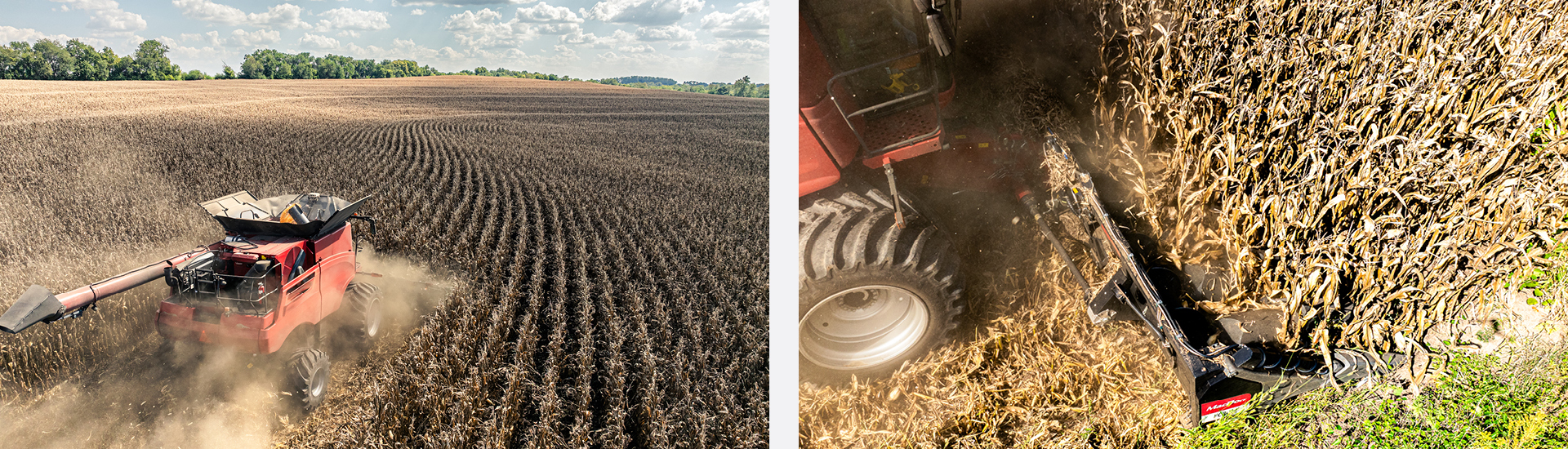
When an opportunity arose to demo the 12-row FlexCorn™ header after a conversation with their local dealer, Barr jumped at the chance to give it a try and see what the most up-to-date corn-harvesting technology has to offer.
"It was pretty easy, really," says Barr of going through the process of acquiring a demo unit. For him, it was a matter of letting his local dealership know he was interested and waiting for a call when it was available. MacDon also has an easy demo-request application on its website for customers who prefer taking that route to a MacDon dealer.
At the time of this interview, Barr had only had the FlexCorn™ for a couple of weeks. Still, in the limited time he'd been using it, he was already impressed with many of the distinctive features, from the flex of the wings to OctiRoll™ technology and more.
"We've had it for a while, but we probably only ran 200 or 300 acres through it, something like that. So, we've had it for a couple weeks, but we switched to beans in between. It's been nice to see now because when we started, the corn was running 18-20 per cent, now the corn's dried down to 16, so you can see the difference," Barr says.
"With our other head, we had a lot of problems with fluff building up, and this one seems to be doing really well, so far."
MacDon has offered corn headers since 2019, but the FlexCorn™ header, released in December 2023, is unique thanks to MacDon's FluidMotion™ Hydraulic Flex, a system that supports up to 98% of the header's weight to provide fluid ground following flex. That flex technology makes it an ideal choice for farmers like the Barrs, whose land includes many terraces.
Terracing is relatively common in the midwestern United States. It involves building ridges of earth across fields to help stop or slow down erosion by reducing the water coming off a hillside or other sloped piece of land. Terraces also help reduce soil loss by slowing the water flow, which results in less soil getting washed away.
"So it's kind of a berm, and then it either has to dump into a waterway that lets the water go down to a creek or something, or there will be a riser in it that lets the water go to the creek instead of just cutting a ditch down the hill," Barr says.
"The terrain compared to other places, obviously, you can see all the terraces, and so you have to farm everything kind of on a contour. So you have a lot of point rows, and even though we plant this with a 24-row planter, 60 feet wide, there are very few places where you're using the full 60 feet. Most of the time it's like you're using 40-foot or 20-foot."
This is where MacDon's FluidMotionTM Hydraulic Flex technology comes in clutch; the FlexCorn™wings on both the 12-row and 16-row version of the header have more than 15 degrees of range, and the two pivoting wings independently track steep terraces and uneven ground conditions for a more thorough and even cut of the trickiest patches of any field.
"The flex, it's so smooth. When you go over terraces, it almost rolls with the ground. And it just kind of does it on its own, it's not like I'm over here messing with it. Once you do your calibrations, it just kind of just does it. And it looks a lot nicer, even if you could take a rigid head and get the ear, you would still have these tall stalks out there. At least now it's got a nice level-with-the-ground cut," he says, adding he also appreciates the OctiRoll™ technology.
“The flex, it's so smooth. When you go over terraces, it just almost rolls with the ground.”
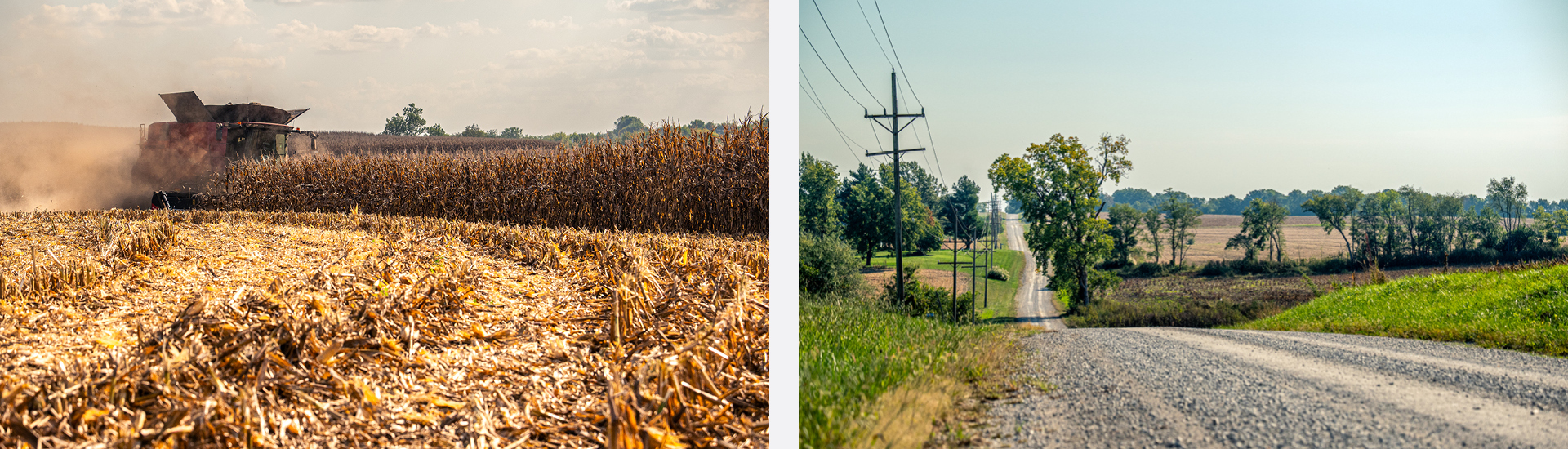
“Even if you could take a rigid head and get the ear, you would still have these tall stalks out there, now it's got a nice level-with-the-ground cut.”
All C Series headers have OctiRoll™, or the OctiRoll™ Residue Management System, which creates well conditioned/chopped and evenly distributed residue, necessary for achieving accurate seed depth and seed placement essential for maximizing successive crop yields. Each front-supported OctiRoll™ uses two sealed double-row ball bearings, and the grease in the cavity forms a barrier to prevent dirt and debris from contacting the bearing seal.
"It's like knives and then it's got interlocking like fingers, too, that help pull the stalk down. I like those," Barr says. "They seem to tear the stalk up pretty nice. I'm curious to see it in the spring how much more it's deteriorated versus what we'll end up shelling with our old head."
“They seem to tear the stalk up pretty nice. I'm curious to see it in the spring how much more it's deteriorated.”
The abundance of terraces doesn't necessarily affect when they start to seed and harvest as much as it influences how they seed and harvest. It's one of the reasons Barr was so eager to get the FlexCorn™ head running in his fields.
"As far as the work in the field, you don't just get to set an A-B line and go back and forth. You can use auto-steer like planting and stuff like that, but a lot of times you've got markers, and you're farming around, and you've got point rows, and it makes things take longer. You know, I think with a 12-row head, if it was flat and square, you know, guys would probably cover 250 acres a day, or 200 acres a day. For us, gosh, if we can get close to 100 acres a day, I mean, we're really doing something," Barr says.
"That was kind of our driving factor into the flex head is the way that we plant with a 24-row planter. We need something that kind of flexes over the terraces. A 30-foot rigid is hard to lay down into the bowl or bend over the top. The way that we plant, we plant with a 24-row planter, and we lay eight down in the channel, and we put 16 off the backside. So we have to be able to flex the corn head over the terrace as we're running along it."
Demoing the FlexCorn™ header is far from the first experience Barr Farms has had with MacDon; they've run MacDon Draper Headers for well over a decade. Barr can't remember the exact date his Dad purchased their first FD70. But even with that familiarity and trust with MacDon products, they appreciate that MacDon's demo program essentially allows for a "try-before-you-buy" situation.
If someone is considering asking MacDon to demo a FlexCorn™ header, Barr offers simple yet practical advice: "I would say it's worth a try for sure."
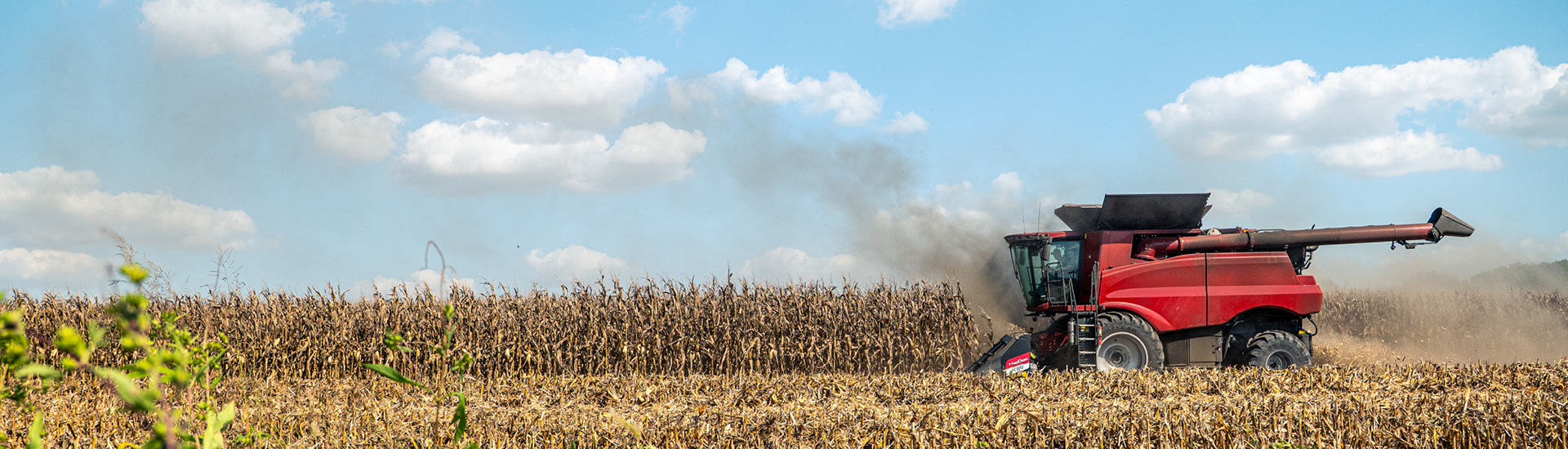
To learn more about MacDon's FlexCorn™ Header, click here or visit your local MacDon Dealer for more detail.
Другие истории

MacDon Performance Stories - Generations of Harvesting Performance.
For generations, the Drummond family of Holland, Manitoba, has built its livelihood around farming and helping producers in their community get more from their harvests with MacDon.
MacDon How To - C Series - IntelliView™ IV Display Configuration
Quinn walks you through how to set up and configure a C3012c Corn Header (30 inch, 12 row, chopping) on a New Holland CR 9.90 Combine Display. These settings are recommended starting points, and can be adjusted based off of user preference feed back from the field.
MacDon Performance Stories - Through Thick and Thin
Nebraska custom harvester Ty Fiscus puts MacDon Windrowers and Rotary Disc Headers to the test in everything from light, drought-stressed crops to 12-foot-tall sorghum.
Don't Miss Out!
Get MacDon news, offers, product announcements, and more directly to your inbox.